 Wander Puerto Rico
Puerto Rico History & Culture: What Every Visitor Should Know
Most visitors arrive knowing two things about Puerto Rico: it's a U.S. territory and you don't need a passport. That's enough to get here, but understanding the island's story — even in broad strokes — transforms the experience. The forts aren't just photo ops; they're the reason the Caribbean looks the way it does. The food isn't just delicious; it's the edible history of three continents colliding on one island. The music isn't just catchy; it carries 500 years of resistance, celebration, and identity.
This guide covers the essentials: enough history and cultural context to make your visit deeper and more meaningful, without turning it into a textbook.
A Brief History
The Taíno People (Pre-1493)
Puerto Rico's original inhabitants, the Taíno, lived on the island they called Borikén (Land of the Brave Lord) for over 1,000 years before European contact. They were farmers, fishers, and skilled craftspeople who lived in organized villages led by caciques (chiefs). Their legacy is everywhere: the words hammock (hamaca), hurricane (huracán), and barbecue (barbacoa) are Taíno. The Caguana Indigenous Ceremonial Park near Utuado has preserved ball courts and petroglyphs. Many Puerto Ricans carry Taíno DNA — genetic studies show indigenous ancestry persists across the population.
Spanish Colonial Era (1493–1898)
Columbus landed in 1493. Juan Ponce de León became the first governor in 1509, establishing San Juan as one of the oldest European settlements in the Americas. Spain built massive fortifications — El Morro (1539) and San Cristóbal (1783) — to defend the island from English, Dutch, and pirate attacks. These are the forts you walk through in Old San Juan today. Spain brought Catholicism, the Spanish language, and architectural traditions. They also brought the transatlantic slave trade — enslaved Africans were brought to work sugar plantations, and their cultural contributions (music, food, spiritual practices) became inseparable from Puerto Rican identity.
U.S. Territory (1898–Present)
The U.S. acquired Puerto Rico after the Spanish-American War in 1898. Puerto Ricans became U.S. citizens in 1917 (via the Jones Act). In 1952, Puerto Rico adopted its own constitution and became the Commonwealth of Puerto Rico (Estado Libre Asociado). Today, Puerto Ricans are U.S. citizens who can travel freely to the mainland, serve in the U.S. military, and are subject to federal law — but cannot vote in presidential elections and have only a non-voting representative in Congress. The island's political status remains the most debated topic in Puerto Rican politics.
What This Means for Visitors
Puerto Rico's complex political status isn't just academic — it shapes daily life. The island uses U.S. dollars, follows U.S. federal law, and your phone works here. But Puerto Rico has its own Olympic team, its own Miss Universe contestant, and a fierce cultural identity that is distinctly not "American" in the mainland sense. Respect that: you're visiting a place with its own national identity, even if it shares a flag with the U.S.
The Three Roots
Puerto Rican culture is described as a blend of three roots — Taíno, Spanish, and African. Every part of the culture you'll encounter reflects this mix.
Food
Spanish rice dishes + African root vegetables + Taíno cooking methods = Puerto Rican cuisine. Mofongo (mashed plantains with garlic) has African origins. Arroz con gandules (rice with pigeon peas) is the national dish — Spanish rice technique, African pigeon peas, Taíno sofrito seasoning. Lechón (whole roasted pig) is the centerpiece of celebrations. The food tells the whole story in every bite. Full food guide here.
Music
Bomba — the oldest musical tradition on the island. African-rooted drumming and dance brought by enslaved people. A conversation between drummer and dancer — the dancer leads, the primo (lead drum) follows. Seeing live bomba in Loíza or Santurce is a transcendent experience. Plena — narrative folk music called "the newspaper of the people." Stories of daily life set to panderetas (hand drums). Salsa — born in New York but deeply Puerto Rican. Reggaetón — originated in Puerto Rico in the 1990s from Panamanian reggae en español and hip-hop, now one of the most popular genres on earth.
Art & Craft
Vejigante masks — colorful horned masks used in carnival celebrations. Ponce makes them from papier-mâché; Loíza carves them from coconut shells. Each tradition reflects different cultural roots. Santos — hand-carved wooden saint figures, a 500-year-old folk art tradition. Mundillo — bobbin lace from the town of Moca. Street art — Santurce's walls are covered in murals by local and international artists, making it one of the Caribbean's most vibrant street art districts.
Language
Spanish is the language of daily life — conversation, media, music, government. English is taught in schools and widely spoken in tourist areas. Puerto Rican Spanish has its own accent, vocabulary, and flavor: dropping the final "s" in words, the distinctive "r" sound, and a vocabulary mixed with Taíno and English loanwords. Even a few words of Spanish — "buenos días," "gracias," "con permiso" — earn genuine warmth from locals.
Cultural Sites Worth Visiting
Old San Juan (UNESCO World Heritage Site)
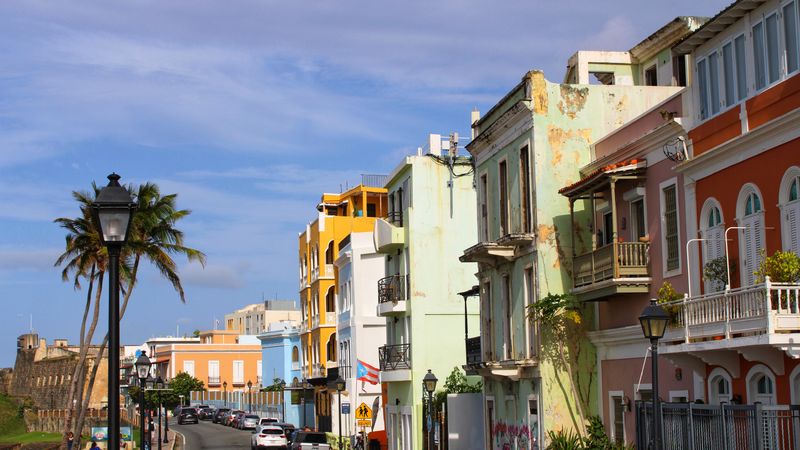
The second-oldest European settlement in the Americas. 500-year-old forts, blue cobblestone streets (made from iron slag used as ship ballast), pastel colonial buildings, and centuries-old churches. Walk El Morro and San Cristóbal — they're not just walls; they repelled attacks from Sir Francis Drake, the Dutch navy, and the U.S. military. Walking tour guide.
Caguana Indigenous Ceremonial Park
Taíno ball courts and petroglyphs in the mountains near Utuado. One of the most important pre-Columbian sites in the Caribbean. Stone-lined plazas where the Taíno played batey (a ceremonial ball game) and carved symbols into the surrounding rocks. Peaceful, uncrowded, and deeply moving — a reminder of the people who named this island. Worth the mountain drive.
Museo de Arte de Ponce
The finest art museum in the Caribbean. European masters and Puerto Rican artists in a building designed by Edward Durell Stone. The collection of pre-Raphaelite art is . Ponce itself is a cultural city with neoclassical architecture, the Parque de Bombas (the iconic red-and-black fire station), and a historic downtown worth a full day trip.
Loíza
The heart of Afro-Puerto Rican culture. This coastal town east of San Juan preserves bomba drumming traditions, coconut-shell vejigante mask-making, and community celebrations that connect directly to African heritage. The annual Fiestas de Santiago Apóstol in July is the cultural highlight. Small restaurants serve traditional dishes. Less touristy, more real.
Coffee Country (Central Mountains)
The mountain towns of Adjuntas, Jayuya, Lares, and Maricao preserve jíbaro culture — the farming traditions of rural Puerto Rico. Coffee haciendas, mountain food (guineos, yuca, viandas), décima poetry, and a slower pace of life that feels centuries away from San Juan. The Ruta Panorámica drive is the best way to experience it.
Cultural Etiquette for Visitors
Greetings
Puerto Ricans greet with warmth. A handshake for first meetings, a kiss on the cheek for acquaintances and friends (one kiss, right cheek). "Buenos días" (good morning), "buenas tardes" (good afternoon), and "buenas noches" (good evening) go a long way. Don't skip greetings — diving straight into a request without saying hello feels rude.
Time
Puerto Rico runs on "island time." Social events start later than scheduled. Dinner reservations at 8 PM are normal. Nightlife doesn't pick up until 11 PM. Don't stress about punctuality in social settings — but tours, flights, and business meetings generally run on time.
Respect
Puerto Rico is not "basically America with beaches." It's a distinct culture with its own identity, pride, and ongoing political complexities. Don't make assumptions about how Puerto Ricans feel about statehood — opinions vary widely. Ask questions with genuine curiosity, not as a quiz. And never call Puerto Rico a country or a foreign destination in conversation — the political status is sensitive, and getting it wrong reads as ignorance.
Tipping
Same as the mainland U.S.: 15-20% at restaurants, $1-$2 per drink at bars, 15-20% for tour guides. Some restaurants add a service charge (look for "propina incluida" on the bill). Tipping is expected, not optional — service workers rely on it.
Walk through 500 years of history with a local guide
Book an Old San Juan Walking Tour →Frequently Asked Questions
What is the history of Puerto Rico?
Puerto Rico was inhabited by the Taíno people for over 1,000 years before Columbus arrived in 1493. Spain colonized the island for 400 years, building the forts and colonial architecture visitors see in Old San Juan today. The U.S. acquired Puerto Rico in 1898 after the Spanish-American War. It became a U.S. territory (commonwealth) in 1952. Puerto Ricans are U.S. citizens but cannot vote in presidential elections.
Is Puerto Rico a country or part of the United States?
Puerto Rico is an unincorporated U.S. territory, officially the Commonwealth of Puerto Rico. It is not a state and not an independent country. Puerto Ricans are U.S. citizens by birth. The island has its own government, governor, and legislature, but is subject to U.S. federal law.
What language do they speak in Puerto Rico?
Spanish is the primary language spoken in daily life. English is also an official language and is widely understood in tourist areas, hotels, and on tours. Road signs are in Spanish. Menus in tourist areas are often bilingual. A few basic Spanish phrases go a long way in showing respect.
What is Puerto Rican culture like?
Puerto Rican culture is a blend of Taíno indigenous, Spanish colonial, and African traditions. Music (salsa, bomba, plena, reggaetón) is central to daily life. Food reflects the same mix. Family and community are paramount. Festivals happen year-round. The culture is warm, expressive, and welcoming to visitors.
What are the most important cultural sites in Puerto Rico?
Old San Juan is a UNESCO World Heritage Site with 500-year-old forts (El Morro and San Cristóbal). The Caguana Indigenous Ceremonial Park has Taíno petroglyphs and ball courts. Ponce's historic district and museums showcase southern culture. Loíza is the center of Afro-Puerto Rican heritage. The central mountains preserve jíbaro (rural farming) traditions.